Policy Factsheet
Ensuring Our Future STEM Workforce: Competitive Compensation for Grad Students and Postdocs
Action
Members of Congress should cosponsor and pass the RESEARCHER Act (H.R.3054/S.1664), as well as the subsequent necessary appropriations for federal science agencies.
Graduate Students Are Key STEM Workers
Graduate school is a full-time job involving research, teaching, and departmental service. Even while taking courses in the first two years, students also begin working in the lab and teaching undergraduate students.
Student Salary: Grad School Is Not Competitive
While graduate students are receiving an education, current stipend rates are a deterrent for pursuing an advanced STEM degree.
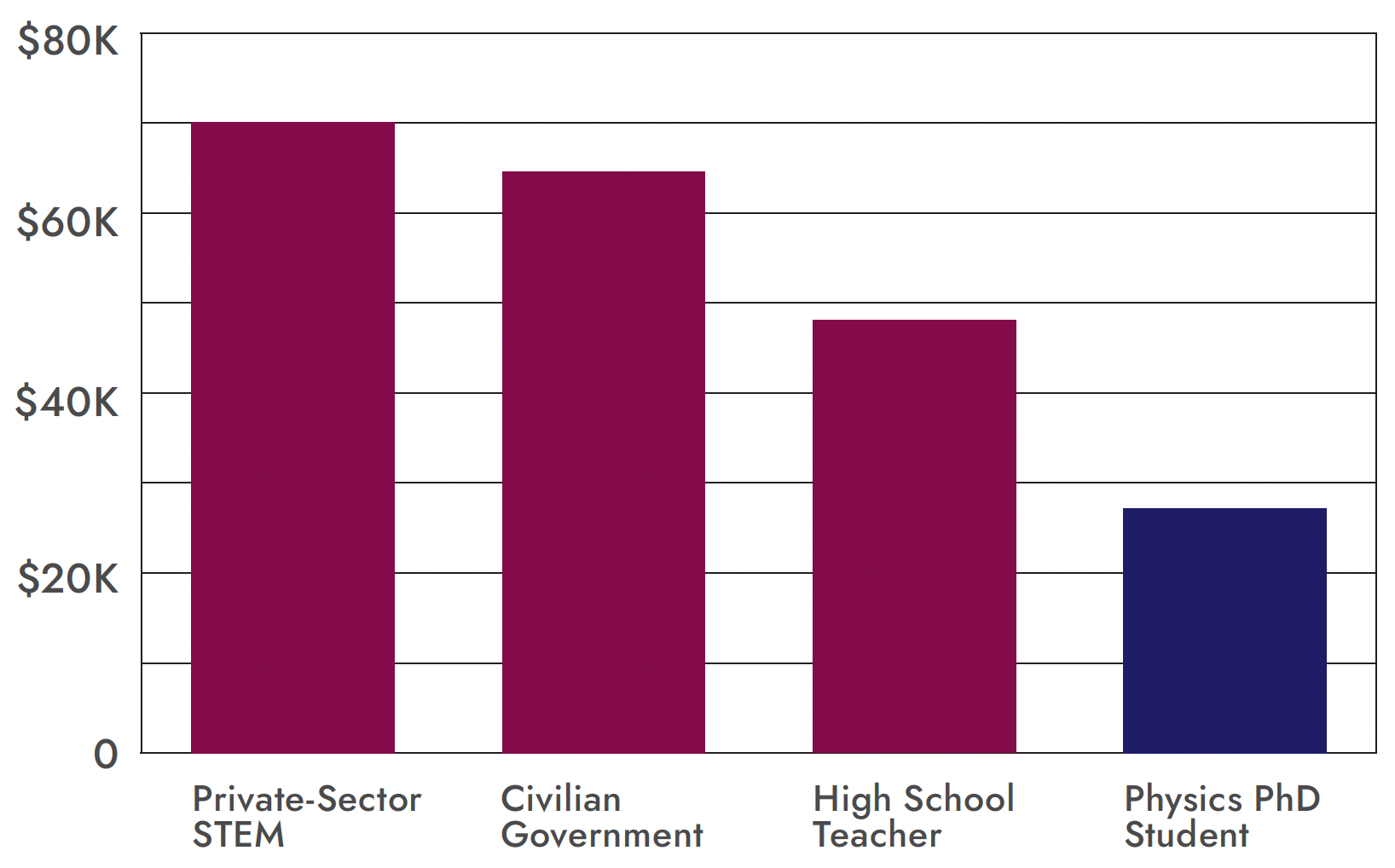
Median annual stipend of 1st year grad students at U.S. PhD-granting physics departments vs. median starting salaries of U.S. physics bachelor’s degree-holders
Source: aip.org/statistics
A Cost-of-Living Crisis
Inaction will exacerbate STEM worker shortages. Most physics departments pay stipends below the living wage needed to rent a two-bedroom apartment with one other person within the university’s zip code.
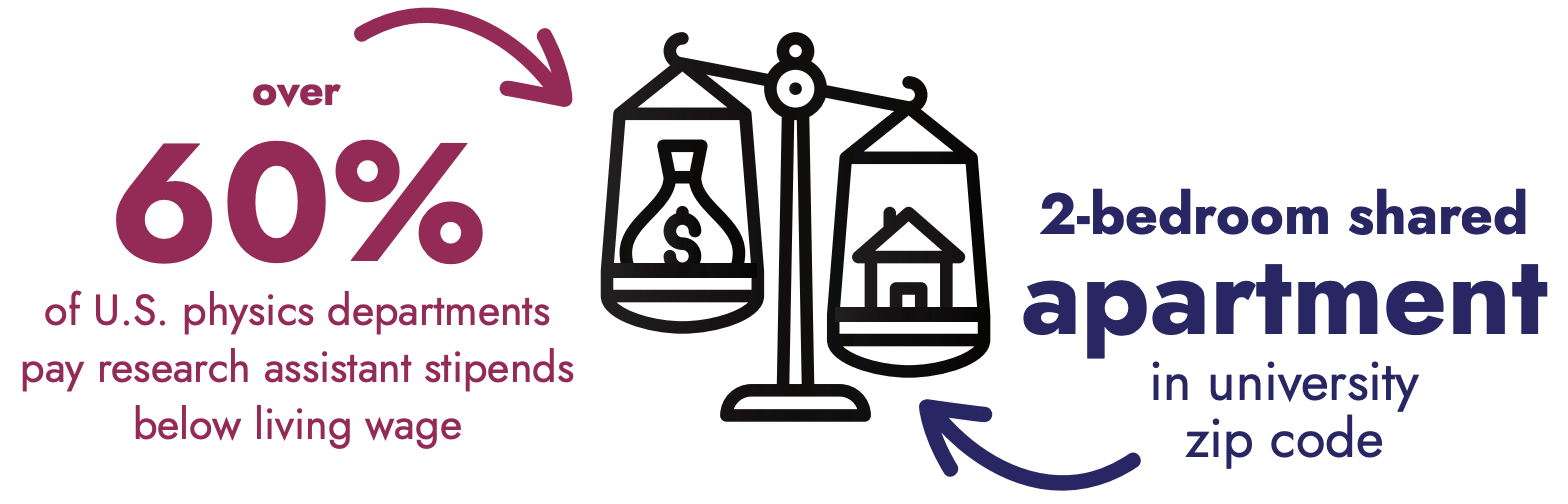
Source: Physics Graduate Student Compensation: Academic Year 2023-24
“We are very concerned about the future of our graduate program if we cannot provide a competitive stipend.”
– Physics Dept Chair, U.S. University
Federal Agencies Play a Critical Role
At U.S. PhD-granting physics departments, more
than half of graduate students are supported
through federal research awards and fellowships.Standard research grants have barely budged in
20 years. What once could sustain 2-3 students
now supports one or fewer.
The RESEARCHER Act Is a Step in the Right Direction
The RESEARCHER Act will help address competitive compensation issues by authorizing data collection and directing the Office of Science and Technology Policy (OSTP) to establish uniform guidelines for federal science agencies. These agencies will then be mandated to develop and implement policies based on OSTP’s guidance, which will also require appropriately augmented appropriations to achieve.